
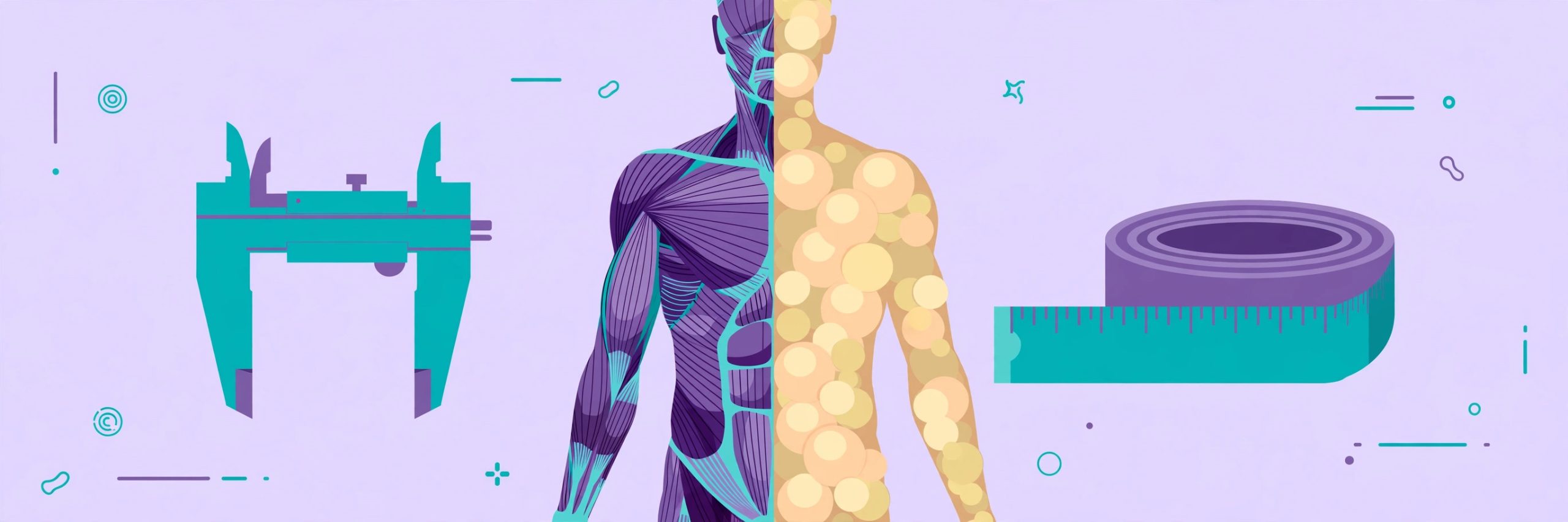
Key takeaways
- Body fat percentage is the share of your weight that is fat; a healthy range is roughly 10–20% for men and 18–28% for women.
- BMI only looks at weight versus height, so two people with the same BMI can have very different body fat percentages — body fat tells you more about composition.
- DEXA scans are the most accurate way to measure body fat, but a tape-measure (U.S. Navy) method gets within a few points for free.
- To lower body fat percentage, combine a modest calorie deficit with strength training and enough protein — diet alone often costs you muscle too.
Your body fat percentage is simply the portion of your total weight that is fat tissue. A 80 kg man at 20% body fat carries 16 kg of fat and 64 kg of lean mass (muscle, bone, water, organs). Everything else being equal, a lower body fat percentage at the same weight means more muscle and better metabolic health.
Unlike the number on the scale, body fat percentage distinguishes what your weight is made of. That distinction matters: muscle is dense and metabolically active, fat is not. Two people can weigh exactly the same and look and perform completely differently because their composition differs.
Body fat percentage vs. BMI: what’s the difference?
BMI (body mass index) is weight divided by height squared. It needs only a scale and a tape measure, which is why doctors and insurers use it. But it can’t tell muscle from fat — a rugby player and a sedentary office worker can share a BMI of 27 while one is lean and the other is not.
Body fat percentage fills that gap by measuring composition directly. Athletes, lifters, and anyone carrying above-average muscle get a fairer picture from body fat than from BMI. That said, BMI still works fine as a rough population screen, and for most non-athletes the two measures move together. If you want the full picture, learn what BMI is and track both numbers. Our free body fat calculator estimates yours from a few tape measurements.
What is a healthy body fat percentage?
Healthy ranges differ by sex because women naturally carry more essential fat (needed for hormones and reproduction). Age matters too — body fat tends to creep up a couple of points per decade even at a stable weight. As a rule of thumb:
| Category | Men | Women |
|---|---|---|
| Athletes | 6–13% | 14–20% |
| Fit / active | 14–17% | 21–24% |
| Average / healthy | 18–24% | 25–31% |
| High (consider action) | 25%+ | 32%+ |
Below about 5% for men or 12% for women, essential fat drops low enough to disrupt hormones, immunity, and — in women — menstrual cycles. Those single-digit numbers you see on stage-ready bodybuilders are temporary and not a health target.
Not all body fat is the same
Where your fat sits matters as much as how much there is. Subcutaneous fat is the soft layer under your skin — the kind you can pinch. Visceral fat wraps around your organs deep in the abdomen, and it is the more dangerous of the two: high visceral fat is linked to heart disease, type 2 diabetes, and insulin resistance even in people whose total body fat looks moderate.
Waist circumference is a decent proxy for visceral fat. As a rough screen, health guidelines flag a waist above 102 cm (40 in) for men or 88 cm (35 in) for women as elevated risk, regardless of weight. If your body fat percentage is “healthy” but your waist is high, visceral fat is the likely culprit — and it responds well to the same prescription: a calorie deficit, regular cardio, and less alcohol and sugary drinks.
Some fat, though, is non-negotiable. Essential fat — roughly 3–5% for men and 10–13% for women — cushions organs, regulates hormones, and keeps your nervous system working. Dieting below essential levels is where health problems start, which is why aggressive cuts past the “athlete” range are a bad idea without professional guidance.
How can I measure my body fat?
Methods range from free to expensive, and accuracy roughly follows price. Here is how the common options compare:
| Method | Accuracy | Cost |
|---|---|---|
| DEXA scan | Gold standard, ±1–2% | $50–$150 per scan |
| Hydrostatic weighing | Excellent, ±2% | $40–$75; hard to find |
| Skinfold calipers | Good if done by a trained tester, ±3–4% | $5–$20 for calipers |
| Tape measure (U.S. Navy method) | Fair, ±3–4% | Free |
| Bioimpedance scale | Variable, ±3–8% | $30–$100 for the scale |
Bioimpedance scales are the most popular home option, but their readings swing with hydration, meal timing, and even skin temperature — the same person can see 3–4 points of difference morning versus evening. Use them for trends under consistent conditions (same time of day, same hydration), not for the absolute number.
Whatever method you choose, measure under the same conditions each time and no more than once a week — daily fluctuations are noise. Tape measurements in the morning before eating, or a scale reading at the same time of day, give the cleanest trend lines. Record the numbers somewhere you will actually look at them; a simple notes app beats a forgotten spreadsheet.
How the U.S. Navy method works
The Navy method estimates body fat from circumference measurements plugged into a validated formula — it’s the same approach the U.S. military uses for fitness screening. Men measure height, neck, and waist; women add hips. Our army body fat calculator uses the closely related military tape-test formula.
A quick example: a man who is 180 cm tall with a 40 cm neck and a 90 cm waist comes out at roughly 18.4% body fat — squarely in the healthy range. A woman at 165 cm with a 34 cm neck, 75 cm waist, and 95 cm hips lands around 26.4%, also healthy. Two tape measurements and thirty seconds give you a number good enough to plan around.
How do I lower my body fat percentage?
Body fat percentage drops when you lose fat while keeping muscle. That second part is what most diets get wrong — a crash diet that sheds muscle along with fat can leave your percentage barely changed even as the scale drops.
- Eat in a modest deficit: about 300–500 calories below maintenance per day. That pace loses roughly 0.4–0.5 kg of fat per week without tanking your energy.
- Lift weights 2–4 times a week: strength training signals your body to keep muscle while it burns fat. Cardio helps the deficit, but lifting protects the composition.
- Eat enough protein: around 1.6–2.2 g per kg of body weight daily while dieting. Protein is the most muscle-sparing macronutrient and the most filling.
- Sleep 7–9 hours: short sleep raises hunger hormones and has been shown to shift weight loss toward muscle instead of fat.
Track your lean mass separately as you go — our lean body mass calculator shows whether your plan is burning fat or muscle. For the full nutrition and exercise picture, read our healthy living basics guide.
This article is for general information only and isn’t medical advice — talk to your doctor before changing your diet or exercise routine.
FAQs
What is a healthy body fat percentage for a man?
For most men, 10–20% is considered healthy, with 14–17% typical for active individuals and 6–13% for athletes. Above 25% is generally considered high and worth addressing. These are guidelines, not diagnoses — how you feel and perform matters too.
What is a healthy body fat percentage for a woman?
For most women, 18–28% is considered healthy, with 21–24% typical for active individuals and 14–20% for athletes. Women need more essential fat than men for hormonal health, so their healthy range sits higher. Above 32% is generally considered high.
Can I measure body fat accurately at home?
Reasonably, yes. The tape-measure Navy method and skinfold calipers get within about 3–4 percentage points of lab values when done carefully — good enough to track progress. Smart scales are convenient but their readings swing with hydration, so compare only same-time, same-condition readings.
Is body fat percentage better than BMI?
For individuals, usually yes — it measures composition directly instead of inferring it from weight and height. BMI mislabels muscular people as overweight and can miss “skinny fat” (normal weight, high body fat). BMI still works as a quick population-level screen, but body fat percentage is the better personal metric.
How fast can I lower my body fat percentage?
A realistic pace is about 0.5–1 percentage point per month for most people, driven by a 300–500 calorie daily deficit plus strength training. Faster cuts usually cost muscle. Expect the mirror and the tape measure to move before any single method’s number does.