
Key takeaways
- With a Roth IRA, you pay tax on contributions now and withdraw the money tax-free in retirement. It usually wins if you expect to be in a higher tax bracket later in life.
- With a Traditional IRA, you typically deduct contributions now and pay tax when you withdraw. It usually wins if you’re in a high tax bracket today and expect a lower one in retirement.
- The growth is identical either way: $6,000 invested yearly at 7% for 30 years becomes about $567,000 in both accounts. The only real question is when you pay tax.
- If you’re unsure, splitting contributions between both accounts gives you tax diversification — the flexibility to pull from whichever account costs less in tax in any given year.
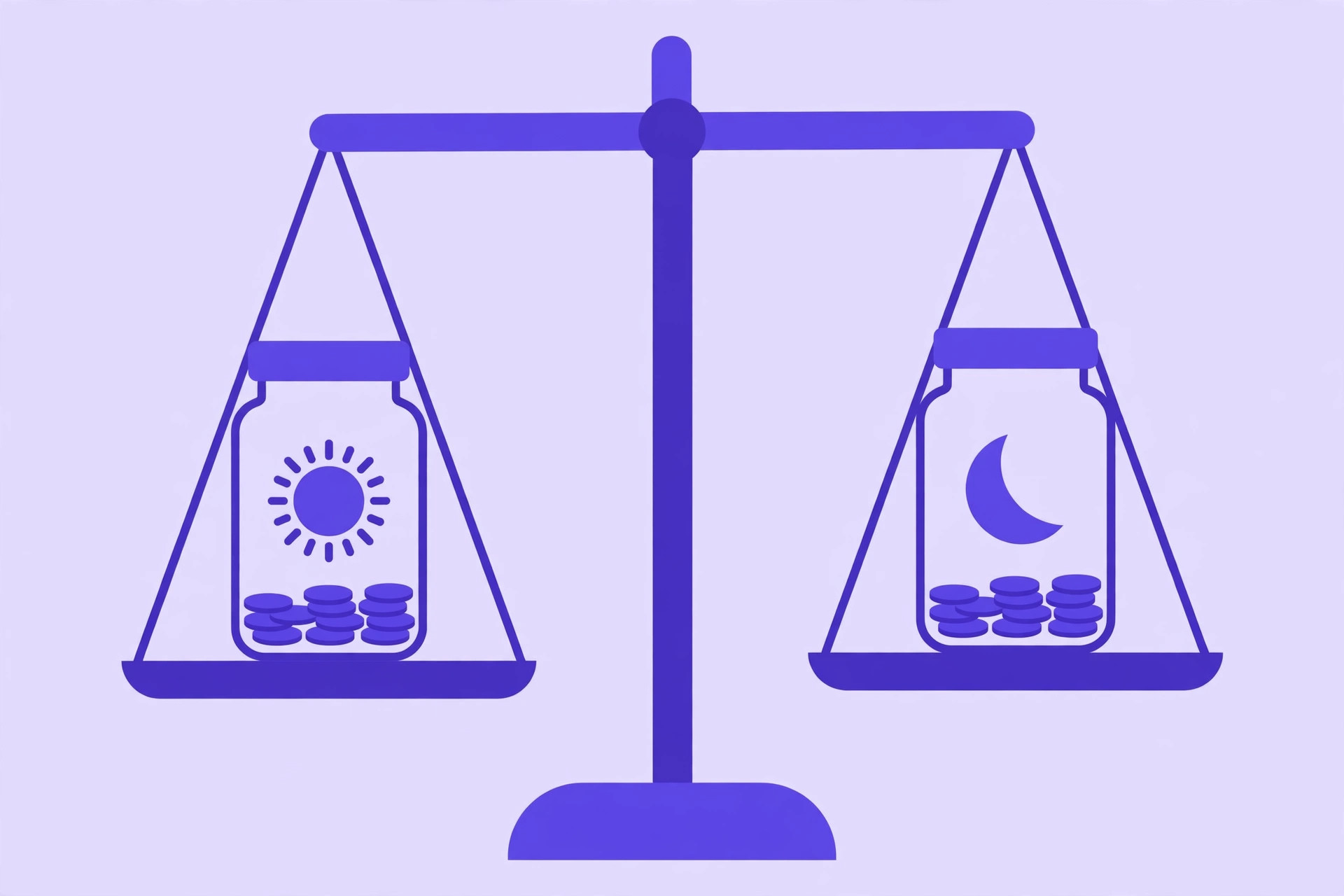
The Roth IRA vs Traditional IRA choice comes down to one question: do you want your tax break now, or later? Both are individual retirement accounts. Both share the same annual contribution limit and offer the same investment choices — stocks, bonds, funds. The entire difference is about timing: a Roth taxes you on the way in, a Traditional taxes you on the way out. If you’re new to these concepts, our guide to personal finance basics covers the foundations first.
This guide walks through how each account is taxed, compares them side by side, and gives you a decision framework based on your current and expected tax brackets — plus a worked 30-year example so you can see the math for yourself.
What Is the Core Difference?
A Roth IRA is funded with after-tax dollars. You get no deduction today, but qualified withdrawals in retirement — contributions and earnings — are completely tax-free, provided you’re 59½ and the account has been open at least five years.
A Traditional IRA works in reverse. Contributions are typically tax-deductible now (income limits apply if you or your spouse is covered by a workplace retirement plan), the money grows tax-deferred, and you pay ordinary income tax on withdrawals in retirement.
Neither account is objectively better. The right choice depends on your current tax bracket versus the bracket you expect in retirement — which is exactly what the framework below helps you figure out.
How Roth IRA Taxes Work
You contribute money you’ve already paid tax on. From there, everything grows tax-free, and qualified withdrawals are tax-free too. There are two underappreciated advantages worth knowing.
First, flexibility. You can withdraw your contributions (not earnings) at any time, for any reason, with no tax or penalty. That makes a Roth a more forgiving account if life throws a curveball — though raiding retirement savings should still be a last resort.
Second, no required minimum distributions. Traditional accounts force you to start withdrawing (and paying tax) in your 70s. Roth IRAs impose no RMDs on the original owner, so the money can keep growing untouched for as long as you like — useful for estate planning.
The trade-off is straightforward: you give up a tax deduction today. If you’re in a high bracket now, that deduction is worth real money.
How Traditional IRA Taxes Work
You contribute pre-tax (or deductible) dollars, lowering this year’s taxable income. A $6,000 contribution in the 24% bracket saves you $1,440 on this year’s tax bill. The money compounds tax-deferred for decades.
The bill comes due in retirement: every dollar you withdraw is taxed as ordinary income. And unlike a Roth, the IRS requires minimum distributions starting in your 70s, whether you need the money or not — those forced withdrawals can push you into a higher bracket.
Early withdrawals (before 59½) generally trigger a 10% penalty on top of taxes, with some exceptions. So a Traditional IRA rewards patience and punishes early taps more harshly than a Roth.
Roth vs. Traditional IRA: Side-by-Side Comparison
| Roth IRA | Traditional IRA | |
|---|---|---|
| Tax on contributions | Paid now (after-tax dollars) | Deducted now (usually pre-tax) |
| Tax on qualified withdrawals | None | Taxed as ordinary income |
| Required minimum distributions | None for the original owner | Required starting in your 70s |
| Early access to contributions | Anytime, tax- and penalty-free | 10% penalty plus taxes before 59½ (some exceptions) |
| Best for | Lower bracket now, higher later; young earners | High bracket now, lower later; peak earners |
Which IRA Is Better for You?
Forget rules of thumb about age. The decision is a tax-bracket comparison: your marginal rate today versus your expected marginal rate in retirement.
Choose Roth if you’re early in your career, in a low bracket now, or expect higher income later — from career growth, a pension, or large required distributions. Paying 12% or 22% today to avoid 28%+ later is a clear win.
Choose Traditional if you’re in your peak earning years. Deducting at 32% or 35% today and withdrawing at 22% in retirement is equally clear math in the other direction.
Split if you’re unsure. Many savers contribute to both. That tax diversification lets you manage your bracket year by year in retirement — pulling from the Roth in high-income years and the Traditional in low ones. It also protects you against future tax-law changes: whatever Congress does, you’ll have money on both sides of the line. If you also have a workplace plan, model the combined picture with our retirement and 401(k) calculator.
One more factor: revisit the choice as life changes. The right answer at 25 is rarely the right answer at 55. A quick annual check — are you still in the bracket you expected? — keeps the strategy aligned with reality.
Worked Example: $6,000 a Year for 30 Years
Take $8,000 of pre-tax earnings each year and a 25% tax bracket, held constant for illustration.
Roth path: you pay 25% tax first, leaving $6,000 to contribute. At 7% annual growth for 30 years, that becomes about $567,000 — every dollar yours, tax-free.
Traditional path: the full $8,000 goes in pre-tax and grows to about $756,000. At withdrawal you pay 25% ($189,000 in tax) and keep about $567,000.
Identical outcome — which is the point. When your tax rate is the same now and later, the accounts tie. The tie breaks the moment rates differ: pay 25% now but only 15% in retirement, and Traditional wins by a wide margin. Expect 22% now and 32% later, and Roth wins. Test your own scenarios — different brackets, different timelines — in our Roth vs. Traditional IRA calculator. Then work out how much you should save for retirement overall.
3 Mistakes to Avoid
1. Assuming Roth is always better. It’s the trendier choice, but a high earner deducting at 35% and withdrawing at 22% beats the Roth by a mile. Run your brackets, not the hype.
2. Ignoring the five-year rule. Roth earnings withdrawn before the account is five years old (and before 59½) can be taxed and penalized, even if you’re otherwise eligible. The clock starts with your first contribution.
3. Forgetting you can use both. There’s no rule forcing one account. Splitting contributions is often the smartest answer for anyone whose future tax rate is genuinely uncertain.
For more tools, browse all our financial calculators.
FAQs
Can I contribute to both a Roth and a Traditional IRA?
Yes. The IRS sets a single annual contribution limit that applies across both accounts combined, so you can split it however you like — for example, half to each. This is the simplest form of tax diversification, and it keeps your options open if your tax situation changes.
What if I earn too much to contribute to a Roth IRA directly?
Direct Roth contributions phase out above certain incomes, but the “backdoor Roth” — contributing to a Traditional IRA and converting it — remains a widely used workaround. The rules have nuances (including the pro-rata rule if you hold other pre-tax IRA balances), so confirm the current regulations before executing one.
Do Roth IRAs have required minimum distributions?
No — Roth IRAs never impose RMDs on the original owner, so the balance can compound untouched for life. Traditional IRAs, by contrast, require minimum distributions starting in your 70s, and each distribution is taxed as ordinary income.
Can I withdraw Roth contributions before retirement?
Yes. Your original contributions (not the earnings) can be withdrawn at any time, for any reason, with no tax or penalty. Earnings withdrawn before 59½ and the five-year mark are a different story — those can trigger taxes and a 10% penalty.
Should I convert my Traditional IRA to a Roth?
A Roth conversion can make sense in a low-income year — a gap year, early retirement, or a sabbatical — because you’ll pay tax on the converted amount at that year’s lower rate. Just be sure you can cover the tax bill from outside the account, or the math deteriorates quickly.