Key takeaways
- How to count macros in four steps: set your calorie target, set protein at 1.6–2.2 g per kg of body weight, set fat at 0.8–1 g per kg, and let carbs fill the remaining calories.
- Protein and carbs each contain 4 kcal per gram; fat contains 9 kcal per gram — that’s the only math you need.
- An 80 kg person eating 2,200 kcal a day lands at roughly 160 g protein, 70 g fat, and 232 g carbs.
- Weigh your food for the first two weeks. After that, your eyeball estimates get surprisingly accurate.
If you’ve ever wondered how to count macros without turning every meal into a math exam, here’s the short version: you set daily targets for protein, fat, and carbs in grams, then track what you eat against them. It takes about ten minutes a day once the habit is set, and it works for fat loss, muscle gain, or just eating with more intention. This guide walks through the whole method with a full worked example. If you’d rather skip the arithmetic, our free macro calculator will generate your targets in seconds.
What are macros, exactly?
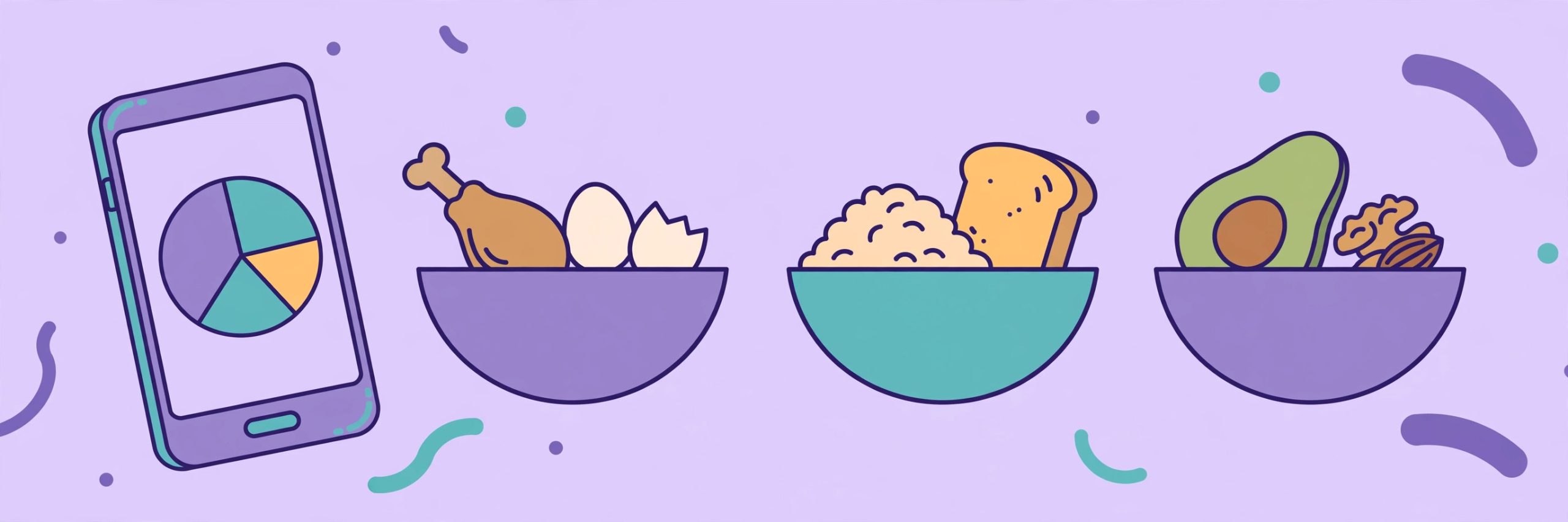
“Macros” is short for macronutrients: protein, carbohydrates, and fat. They’re called macro because your body needs them in large amounts, unlike micronutrients (vitamins and minerals) needed in tiny doses. Every calorie you eat comes from one of these three.
Each macro carries a fixed amount of energy:
- Protein: 4 kcal per gram
- Carbohydrates: 4 kcal per gram
- Fat: 9 kcal per gram
That difference matters. Two hundred calories could be 50 grams of carbs (a big bowl of rice) or about 22 grams of fat (a small handful of nuts plus cooking oil). Counting macros, rather than just calories, tells you what kind of calories you’re eating — which is what determines whether you keep your muscle while losing fat, or just get smaller in every direction.
Step 1: Set your calorie target
Everything hangs on total calories. Macros are just a way of splitting that calorie budget into useful pieces. If your target is wrong, perfect macros won’t save it.
Your starting point is your maintenance level — the calories that keep your weight stable. From there, subtract 300–500 for fat loss, or add 200–300 for muscle gain. The honest way to find maintenance: track your food and your morning weight for two weeks, then adjust. The fast way: use our calorie calculator for an evidence-based estimate, then fine-tune based on what the scale does over the next two to three weeks.
For the worked example below, we’ll use a 2,200 kcal daily target for an 80 kg person aiming for slow fat loss.
Step 2: Set protein first
Protein gets first pick because it’s the macro that protects your muscle, keeps you full, and costs the most energy to digest. The evidence-based range for active people is 1.6–2.2 grams per kilogram of body weight per day.
For our 80 kg example, that range is 128–176 g. We’ll take 160 g (exactly 2.0 g/kg) — the top half of the range suits a fat-loss phase, when muscle is most at risk. In calories: 160 × 4 = 640 kcal from protein.
If you’re cutting, err toward the higher end; if you’re maintaining or gaining, the middle of the range is plenty. For a deeper look at dialing this in, see our guide on how much protein you need per day, or run your numbers through the protein calculator.
Step 3: Set your fat target
Fat is essential — your hormones, brain, and vitamin absorption all depend on it — so it gets set second. The practical range is 0.8–1 gram per kilogram of body weight, which for most people lands between 20–35% of total calories. Going below about 0.6 g/kg for long stretches is where hormonal problems start showing up.
For our 80 kg example: 70 g of fat (0.875 g/kg). In calories: 70 × 9 = 630 kcal, about 29% of the day’s total. If you prefer fattier foods, take the higher end; if you love carbs, take the lower end. Either works as long as you stay in the range. The fat intake calculator can pin this to your exact target.
Step 4: Fill the rest with carbs
Carbs get whatever calories are left. They’re your body’s preferred fuel for training and daily activity, and they’re the most flexible macro — high on training days, lower on rest days, whatever fits your life.
Here’s the full calculation for our example:
- Total target: 2,200 kcal
- Protein: 160 g × 4 = 640 kcal
- Fat: 70 g × 9 = 630 kcal
- Remaining for carbs: 2,200 − 640 − 630 = 930 kcal
- Carbs in grams: 930 ÷ 4 = 232.5 g ≈ 232 g
Final targets: 160 g protein / 70 g fat / 232 g carbs — 2,200 kcal. Notice carbs weren’t chosen; they were derived. That’s the whole method: protein and fat are anchored to your body weight, carbs absorb the rest.
What does this look like as a real day of eating?
Targets are abstract until they’re food. Here’s a day that hits 160 g protein, 70 g fat, and 232 g carbs almost exactly:
| Meal | Example foods | Protein | Fat | Carbs |
|---|---|---|---|---|
| Breakfast | Greek yogurt, oats, berries, honey | 38 g | 18 g | 55 g |
| Lunch | Chicken rice bowl with veg and olive oil | 45 g | 22 g | 60 g |
| Snack | Protein shake and a banana | 25 g | 8 g | 30 g |
| Dinner | Salmon, potatoes, mixed vegetables | 52 g | 22 g | 87 g |
| Total | 160 g | 70 g | 232 g |
That’s roughly 2,200 kcal across four normal meals — no tilapia-and-asparagus misery required. The pattern to copy: a palm-sized protein portion at every meal, carbs clustered around your most active hours, and fats coming mostly from cooking oils, nuts, and the protein sources themselves.
5 tracking tips that actually work
1. Buy a digital food scale. It’s the single highest-ROI purchase in nutrition. Weigh everything for the first two weeks; your estimates after that will be close enough for real life.
2. Log before you eat, not after. Pre-logging turns the app into a plan instead of a confession. It takes the same two minutes and removes all the “oops” entries.
3. Track protein first. On chaotic days, just hit your protein target and stay near your calories. Perfection across all three macros every single day is unnecessary — weekly averages are what change your body.
4. Build a rotation of repeat meals. Five breakfasts and five dinners you like, saved as recipes in your tracker. Variety is nice; consistency is what gets results.
5. Don’t chase the numbers to the gram. Landing within ±10 g on protein and ±15 g on carbs and fat is a perfect day. Stressing over 4 grams of carbs is how people quit in week three.
FAQs
How long does it take to see results from counting macros?
Most people notice changes in energy and fullness within two weeks, and visible body-composition changes in 6–8 weeks of consistent tracking. The scale moves first (water and glycogen), then measurements and photos catch up. Take progress photos every two weeks — the mirror lies daily but tells the truth monthly.
Do I need to hit my macros exactly every day?
No. Aim for protein within about 10 grams and carbs and fat within about 15 grams of target. What matters is the weekly average, not any single day. One off-plan day in a consistent week changes almost nothing physiologically.
Should my macros be different on rest days?
They can be, but most beginners do better keeping them constant — simpler means more consistent. If you train hard 4+ days a week, shifting 30–50 g of carbs from rest days to training days is a reasonable refinement once the basics are automatic.
Can I count macros without a food scale?
You can, using hand portions (palm = ~30–40 g protein, fist = ~1 cup carbs, thumb = ~1 tbsp fats), but expect your estimates to be off by 20–30% at first. A scale for two weeks calibrates your eye permanently. It’s the difference between guessing and knowing.
Is counting macros safe?
For most healthy adults, yes — it’s just structured eating. But if you have a history of disordered eating, macro tracking can become obsessive; in that case, work with a dietitian instead of an app. This article is for general information only and isn’t medical advice — talk to your doctor before changing your diet or exercise routine.
That’s the complete method: calories first, protein anchored to body weight, fat in its range, carbs fill the rest. Run your own numbers with the macro calculator, and for the bigger picture on building healthy habits around your nutrition, see our healthy living guide for beginners.