
Key takeaways
- If you’re asking how does compound interest work, the core idea is simple: you earn returns on your past returns, so your balance grows faster every year you leave it alone.
- $1,000 invested at a 7% annual return becomes $1,967 after 10 years, $3,870 after 20 years, and $7,612 after 30 years.
- Starting early beats chasing higher returns: $5,000 invested at age 25 grows to about $74,900 by 65 at 7%, versus about $38,100 if you wait until 35.
- Regular contributions multiply the effect: $200 a month at 7% for 30 years grows to roughly $244,000, even though you only put in $72,000.
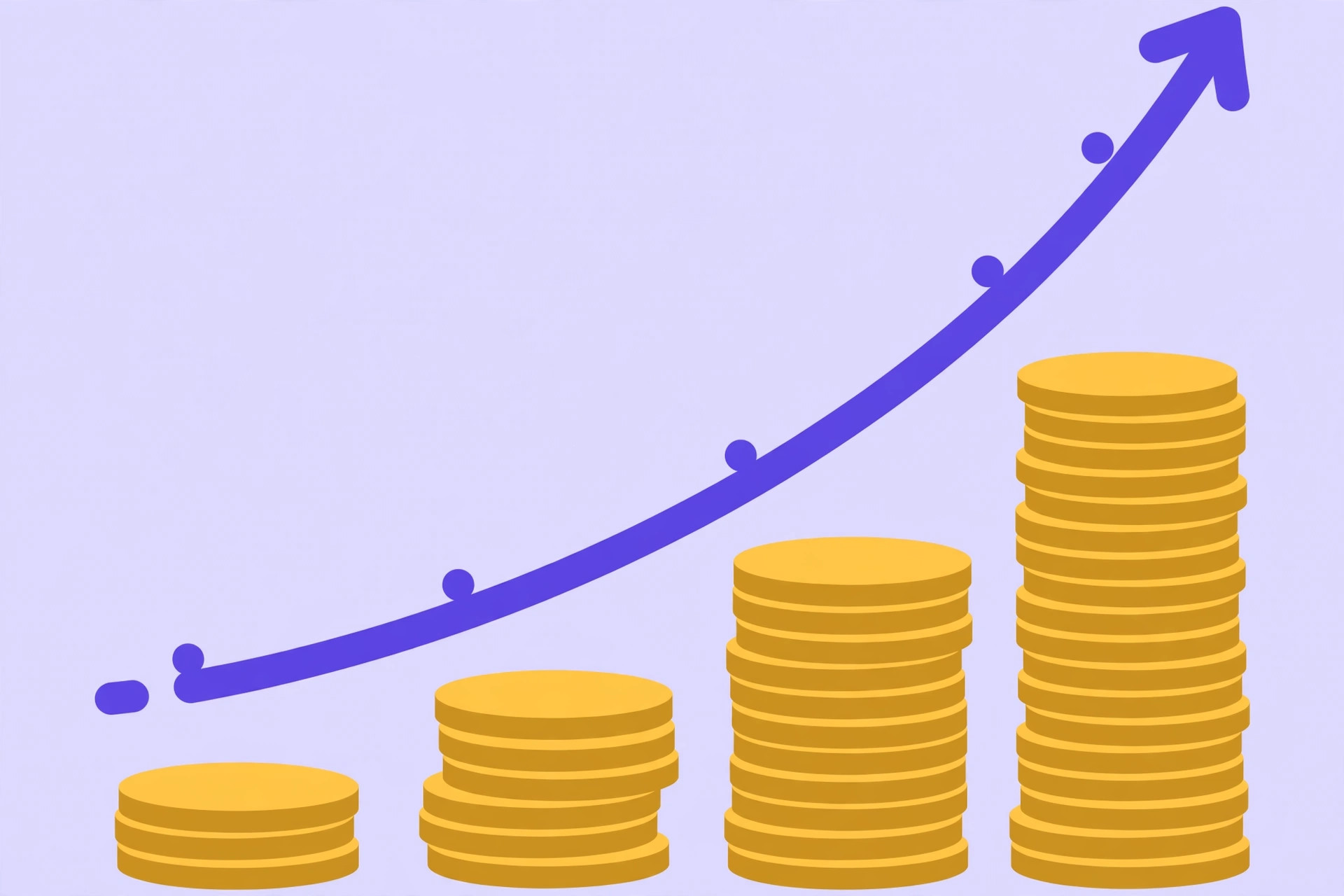
If you have ever wondered how does compound interest work, here is the short version: your money earns a return, and then that return starts earning returns of its own. Each year the growth builds on a bigger base, so the curve bends upward over time. It is the reason small, steady investments can turn into serious money — and the reason high-interest debt is so punishing.
In this guide you will see the exact formula, real numbers showing what $1,000 becomes over 10, 20, and 30 years, and why the calendar matters more than picking the perfect investment. All examples use a 7% annual return, roughly the stock market’s long-run average after inflation.
What Is Compound Interest, Exactly?
Compound interest is interest calculated on both your original deposit and the interest it has already earned. In year one, you earn 7% on $1,000. In year two, you earn 7% on $1,070 — the original thousand plus last year’s $70 of growth. That extra $4.90 in year two looks trivial. Over decades, it becomes the dominant force in your balance.
The alternative is simple interest, which pays only on the original principal, year after year. Almost nothing you actually encounter — not savings accounts, not index funds, not credit cards — works that way. Compounding is the default in real finance, which is why understanding it pays off in every money decision you make.
The Compound Interest Formula
The whole idea fits in one line:
A = P(1 + r)t
- A is the final amount.
- P is the principal — what you start with.
- r is the annual rate as a decimal (7% = 0.07).
- t is the number of years.
For example: $1,000 at 7% for 10 years gives A = 1000 × (1.07)10 = 1000 × 1.96715 = $1,967.15. The exponent t is doing all the heavy lifting — that is why time matters so much. If mental math is not your thing, plug your own numbers into our compound interest calculator and watch the curve move as you change the inputs.
A Real Example: What $1,000 Becomes at 7%
Here is the year-by-year picture for a single $1,000 deposit earning 7% annually, with nothing added and nothing withdrawn:
| After | Balance | Growth so far |
|---|---|---|
| 5 years | $1,402.55 | $402.55 |
| 10 years | $1,967.15 | $967.15 |
| 15 years | $2,759.03 | $1,759.03 |
| 20 years | $3,869.68 | $2,869.68 |
| 25 years | $5,427.43 | $4,427.43 |
| 30 years | $7,612.26 | $6,612.26 |
Look at the rhythm of it. The first decade adds $967. The second decade adds $1,903. The third adds $3,743 — nearly four times what the first decade produced, from the same $1,000 and the same 7%. Nothing changed except time. By year 30, growth ($6,612) is more than six times your original deposit.
Compound Interest vs. Simple Interest
To feel the difference, compare that $1,000 at 7% under both systems:
| After | Simple interest | Compound interest |
|---|---|---|
| 10 years | $1,700.00 | $1,967.15 |
| 20 years | $2,400.00 | $3,869.68 |
| 30 years | $3,100.00 | $7,612.26 |
Simple interest hands you $70 every year, flat, forever: $2,100 of total growth over 30 years. Compounding hands you $6,612 — more than triple. The $4,512 gap between them is money created by returns earning their own returns. This is also why credit card debt at 22% is so destructive: the same math runs in reverse, against you.
Why Starting Early Beats Earning More
Here is the comparison that convinces most skeptics. Two people each invest a single $5,000 deposit at 7% and leave it until age 65:
- Person A invests at 25. The money compounds for 40 years: $5,000 × (1.07)40 = about $74,900.
- Person B invests at 35. The money compounds for 30 years: $5,000 × (1.07)30 = about $38,100.
Same deposit, same return — but waiting ten years cost Person B nearly half the final amount. Because time sits in the exponent of the formula, early years are worth far more than later ones. No realistic difference in investment returns makes up for a lost decade: even if Person B earned 9% instead of 7%, they would still end up with only about $66,300, short of Person A’s $74,900.
This is the mathematical reason retirement advice always stresses starting in your twenties. If you are mapping out your own timeline, read our guide on how much you should save for retirement next.
The Real Multiplier: Monthly Contributions
One deposit is illustrative, but real wealth comes from combining compounding with regular contributions. Invest $200 every month at 7% annual for 30 years and the future value is about $244,000. Your total contributions were only $72,000 (200 × 360 months). Compounding contributed the other roughly $172,000 — more than double what you put in.
That is the power of compounding in its practical form: modest, boring, automatic deposits, left alone for decades. To flip the question around — “how much do I need to save each month to reach $500,000?” — use a savings goal calculator and solve for the monthly amount.
How to Put Compounding to Work for You
- Start now, even if the amount is small. As the example above shows, ten early years beat a bigger deposit later. $100 a month started today beats $200 a month started in ten years.
- Automate your contributions. Money moved automatically on payday gets invested; money left to willpower gets spent.
- Reinvest everything. Dividends and interest must stay in the account to compound. Sweeping them out as cash converts your compounding machine back into simple interest.
- Keep fees low. A 1% annual fee on a 7% return leaves you earning 6%. Over 30 years, $10,000 at 7% becomes $76,123; at 6% it becomes $57,434 — the fee quietly costs you about $18,700.
- Don’t interrupt it. Cashing out resets the exponent to zero. Every withdrawal is a loan from your future self at 7% interest.
These five habits are the backbone of personal finance basics: spend less than you earn, invest the difference automatically, and let time do the compounding.
FAQs
What is compound interest in simple terms?
Compound interest is when your investment’s earnings start earning money themselves. You earn a return on your original deposit plus on all the growth it has already produced, so your balance accelerates the longer you leave it invested.
A useful shorthand: your money grows slowly at first, then faster and faster, because each year’s growth is calculated on a larger base than the year before.
How is compound interest calculated?
Use the formula A = P(1 + r)^t, where A is the final amount, P is your starting principal, r is the annual rate as a decimal, and t is the number of years. For example, $1,000 at 7% for 10 years is 1000 × (1.07)^10 = $1,967.15.
For monthly contributions, the math is more involved — that is what a compound interest calculator is for.
What is the difference between compound and simple interest?
Simple interest pays a fixed amount on your original deposit every period; compound interest pays on the deposit plus all previously earned interest. Over 30 years, $1,000 at 7% simple interest becomes $3,100, while compounding turns it into $7,612.
The longer the timeframe, the wider the gap between the two.
How much will $10,000 grow at 7% over 20 years?
About $38,700. The calculation is 10,000 × (1.07)^20 = $38,696.84. Double the principal from our earlier example and every figure doubles too — compounding scales linearly with the starting amount.
Add $200 monthly contributions on top and those deposits alone grow to roughly $104,000, bringing the combined 20-year total to about $143,000.
Can compound interest work against me?
Yes — credit card debt compounds the same way your investments do, just in the wrong direction. A $5,000 balance at 22% APR left alone would grow instead of shrink, which is why paying more than the minimum matters so much.
The rule is simple: compound your assets, crush your compounding debts.
Ready to run your own numbers? Try the compound interest calculator, or browse our other financial calculators for savings, loans, and retirement planning.